
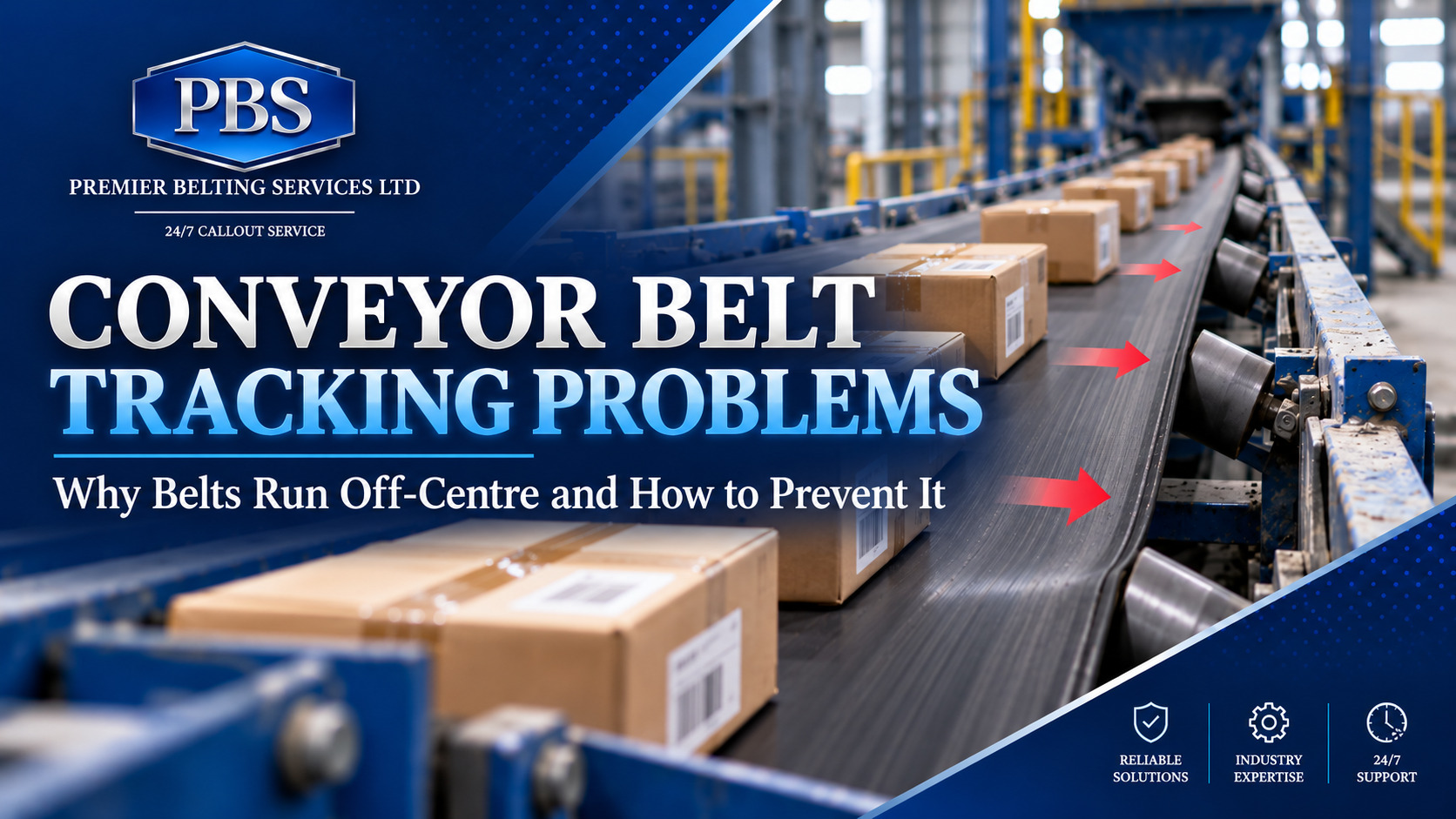
A conveyor belt that repeatedly drifts to one side might seem like a minor inconvenience, but poor tracking can quickly lead to damaged belt edges, unnecessary wear and unexpected production stoppages.
For businesses relying on conveyor systems in manufacturing, warehousing, food processing and industrial operations, keeping belts correctly aligned is an important part of maintaining reliable equipment.
Conveyor belt tracking problems do not always mean the belt itself is faulty. In many cases, the cause lies elsewhere in the system, from worn rollers and uneven loading to incorrect tension or material build-up.
Understanding what causes a belt to run off-centre can help businesses identify problems early and avoid more expensive repairs.
What Causes a Conveyor Belt to Run Off-Centre?
A conveyor belt should travel along its intended path without continuously pulling towards one side of the frame.
When it begins drifting left or right, something is influencing how the belt moves around the conveyor.
The most common causes include:
- Misaligned rollers or pulleys
- Incorrect or uneven belt tension
- Material accumulating around conveyor components
- Products being loaded unevenly
- Worn or damaged rollers
- Problems with the belt joint
- Belt distortion or an unsuitable replacement
Identifying the actual cause is important. Repeatedly adjusting a conveyor without understanding why the belt is moving can make tracking problems worse.
Misaligned Rollers and Pulleys
One of the most common reasons a conveyor belt runs off-centre is incorrect roller or pulley alignment.
Rollers help support and guide the belt through the conveyor system. If one becomes worn, damaged or incorrectly positioned, it can influence the direction in which the belt travels.
Even small alignment differences can become noticeable over a longer conveyor.
The solution usually involves checking the condition and positioning of the rollers, pulleys and supporting structure before making any necessary corrections.
For older conveyors, particularly those that have been modified or repaired several times, it is worth checking that the overall frame remains square.
Incorrect Conveyor Belt Tension
Belt tension has a direct effect on how a conveyor operates.
If the tension is too low, the belt may slip or struggle to maintain consistent movement. Uneven tension across the belt can also contribute to tracking issues.
However, simply increasing the tension is not always the answer.
Excessive tension can place additional strain on bearings, rollers, joints and the belt itself. Any corrections should be made according to the conveyor and belt manufacturer’s specifications.
If tracking problems continue after adjustment, another part of the system may be responsible.
Material Build-Up Around the Conveyor
Dust, grease, product residue and loose materials can accumulate around conveyor rollers and pulleys.
This is particularly relevant in environments such as recycling facilities, agricultural processing plants and industrial manufacturing sites.
Material collecting on one side of a roller can change how the belt makes contact with it, potentially encouraging the belt to move away from its normal position.
Regular cleaning and inspections can help prevent this. The Habasit conveyor belt engineering guide also identifies pulley alignment, conveyor structure and contamination as important factors in maintaining correct belt tracking.
Uneven Loading on the Conveyor
Not every tracking problem is caused by the machinery.
If products or materials are consistently placed towards one edge of the belt, uneven loading can influence how it travels through the system.
This can occur where products enter from another conveyor, chute or production line.
For example, a warehouse conveyor handling cartons may develop tracking issues if packages are repeatedly transferred onto one side. Similar problems can arise when loose materials are discharged unevenly onto a processing conveyor.
Reviewing how products enter and move along the system may reveal an issue that cannot be solved through belt adjustment alone.
Can a Damaged Conveyor Belt Cause Tracking Problems?
Yes. Although many tracking problems originate from the conveyor itself, the condition of the belt can also be responsible.
A belt that has become distorted, stretched unevenly or damaged around the joint may struggle to run consistently.
Signs worth checking include:
- Uneven belt edges
- A damaged or separating joint
- Visible distortion across the belt
- Localised stretching
- Repeated tracking problems following a belt replacement
Where the belt has suffered damage, professional conveyor belt repairs and on-site vulcanising may provide a suitable solution.
However, if the belt has become permanently distorted or is extensively worn, replacing it may be more reliable than repeatedly adjusting the conveyor.
How to Prevent Recurring Conveyor Belt Tracking Problems
Preventing tracking problems starts with understanding how the conveyor normally operates and identifying changes before damage develops.
A sensible maintenance approach includes:
- Inspecting belt edges regularly. Fraying and uneven wear may indicate that the belt is rubbing against part of the conveyor frame.
- Monitoring rollers and pulleys. Damaged, seized or incorrectly aligned components should be investigated.
- Keeping equipment clean. Prevent material from building up around rollers, pulleys and other moving parts.
- Checking product loading. Make sure materials are being introduced onto the conveyor correctly.
- Recording recurring faults. Note whether tracking issues occur continuously, under load or at particular points in operation.
- Reviewing belt condition. A damaged joint or distorted belt may require professional attention.
Importantly, operators should never attempt to guide a moving belt by hand or make unsafe adjustments while equipment is operating.
The Health and Safety Executive’s machinery maintenance guidance explains the importance of safe isolation, suitable maintenance procedures and competent personnel when working on industrial equipment.
Conveyor Belt Tracking Issues Across Manufacturing and Industrial Sites
Conveyor systems are used across a wide range of industries, and the conditions surrounding the equipment can influence how quickly tracking problems develop.
Across Shropshire, major industrial locations such as Hortonwood and Halesfield in Telford support manufacturing, engineering and distribution operations.
Further into Staffordshire, Stoke-on-Trent’s ceramics and manufacturing industries, including facilities around Fenton, Longton and Etruria Valley, often have different material-handling requirements.
Meanwhile, businesses around Dudley and the Black Country operate conveyors within engineering, production, packaging and industrial processing environments.
Although the products being handled vary, the consequences of poor tracking are similar. A belt running against the conveyor frame can suffer premature damage and eventually interrupt production.
Premier Belting Services Ltd supports businesses throughout these regions with services including conveyor belt repairs in Stoke-on-Trent and conveyor belt supply in Dudley, alongside wider UK support for industrial conveyor systems.
When Should You Call a Conveyor Belt Specialist?
If a belt repeatedly moves off-centre despite routine maintenance, it is worth arranging a professional assessment.
Persistent tracking problems can indicate worn components, incorrect installation or damage that requires more than basic adjustment.
A specialist can assess the belt’s condition and help establish whether repairing the existing belt or manufacturing a replacement is the most practical solution.
Premier Belting Services Ltd provides conveyor belt manufacturing, supply, installation and repairs for industrial customers across the UK.
With over 17 years of industry experience, our team works with businesses across manufacturing, distribution, agriculture and processing to provide reliable conveyor belting solutions suited to their equipment.
If your conveyor belt is running off-centre, suffering repeated edge damage or showing signs of wear, contact Premier Belting Services Ltd to discuss your requirements and find the right way forward.
Do you need help from our experts?
Give us a call today to get expert advice and support from our experienced team.