
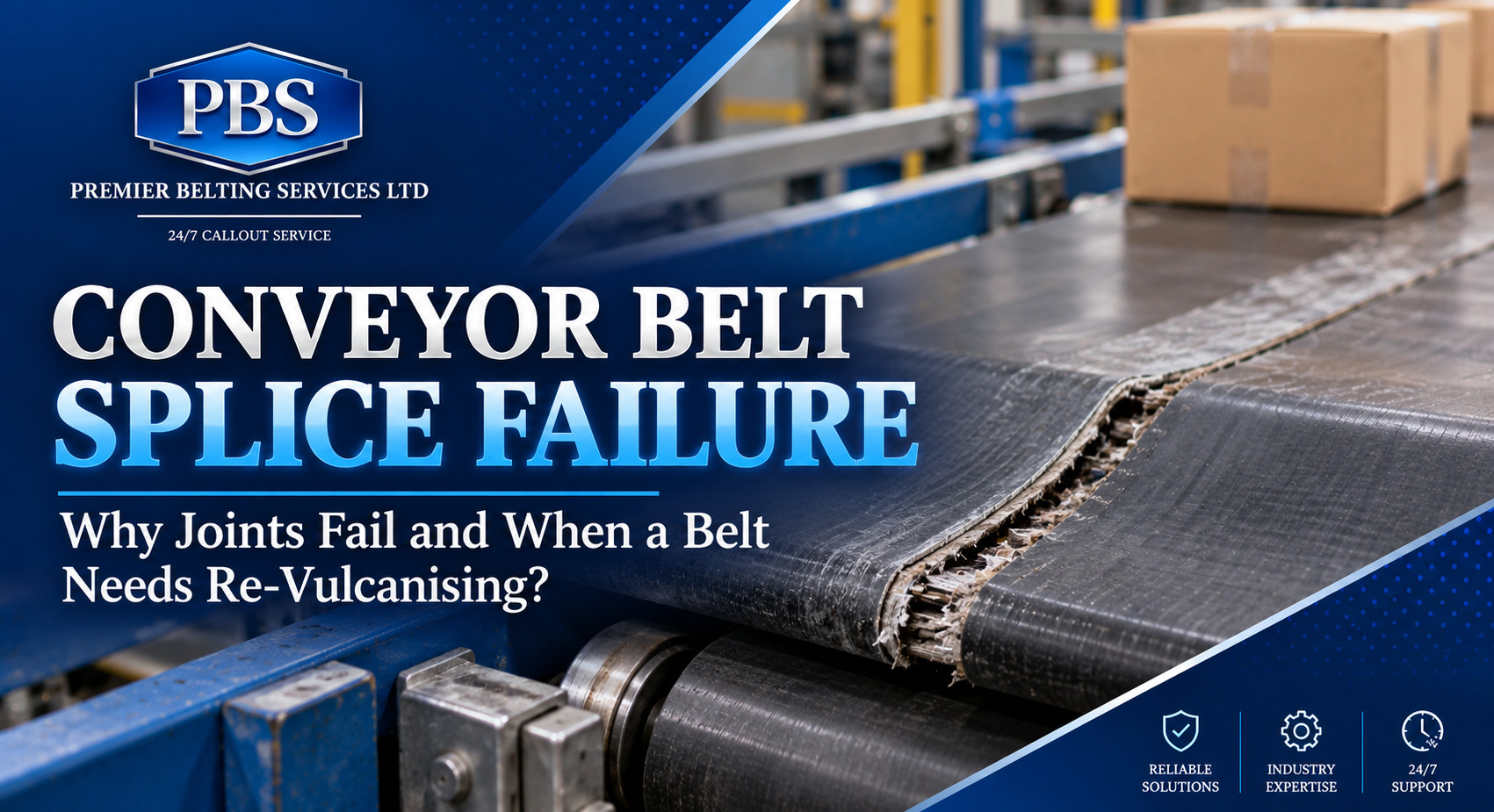
A conveyor belt can appear to be in perfectly reasonable condition, yet still experience a serious breakdown when its joint begins to separate. Known as conveyor belt splice failure, this problem can interrupt production, damage surrounding components and leave businesses facing unexpected downtime.
The splice is the section where the ends of a conveyor belt are joined to create a continuous loop. It must withstand repeated movement around pulleys, operating tension and the demands of whatever materials or products are being transported.
When a splice starts to fail, identifying the cause is just as important as repairing the damage. In some cases, professional re-vulcanising can restore a dependable joint without replacing the entire belt.
What Causes a Conveyor Belt Splice to Fail?
Several factors can contribute to premature joint failure. Some relate to the original joining process, while others develop through everyday operation.
Common causes include:
- Incorrect belt tension: Excessive tension places unnecessary stress on the joint and surrounding belt material.
- Poor belt tracking: A conveyor running off-centre can cause uneven wear and place additional strain on one side of the splice.
- Contamination during joint preparation: Dust, grease or moisture can interfere with proper bonding.
- Incorrect jointing procedures: Unsuitable materials, preparation or bonding conditions can reduce splice strength.
- Repeated bending: A joint may deteriorate prematurely if it is unsuitable for the pulley diameter or belt construction.
- Overloading: Sudden impacts or operating loads beyond the system’s intended capacity can damage a joint.
A splice failure is not necessarily evidence of poor workmanship. Even a correctly manufactured joint can deteriorate if the conveyor is operating under unsuitable conditions.
Early Warning Signs of a Failing Conveyor Belt Joint
Splice problems often become visible before the joint fails completely.
One of the clearest signs is separation along the joint line. This may begin as a small raised edge or opening that gradually becomes more noticeable as the belt continues running.
Other warning signs include:
- Cracks developing around the splice
- Layers of belt material beginning to separate
- Fraying along the joint edges
- A noticeable bump as the splice passes over rollers
- Uneven wear concentrated around the joint
- Changes in tracking whenever the splice passes a pulley
These symptoms should be investigated promptly, particularly on conveyors that form an essential part of a production line.
Continuing to operate with a visibly damaged splice can increase the extent of the failure and may make a straightforward repair more difficult.
Why Does the Same Conveyor Belt Joint Keep Failing?
Repeated splice failure usually suggests that something more than the joint itself needs attention.
For example, a conveyor with incorrect tension may continue damaging new joints even after the original splice has been replaced.
Similarly, worn rollers, misaligned pulleys or a belt consistently running against the conveyor frame can create repeated stress around the joined section.
This is why replacing the splice without examining the wider system may only offer a short-term solution.
Technical guidance published by Agg-Net on professional conveyor belt splicing highlights the importance of choosing the correct joining method and ensuring that the finished splice can handle the belt’s operating conditions.
A proper assessment should consider the existing joint, belt construction, pulley arrangement and any recurring operating problems.
When Does a Conveyor Belt Need Re-Vulcanising?
Re-vulcanising may be appropriate when an existing joint has deteriorated but the surrounding belt remains in good condition.
The damaged splice can potentially be removed or renewed, with the belt ends prepared and joined again using a suitable method for the belt material and construction.
This approach may be worthwhile where:
- Damage is concentrated around the splice.
- The remaining belt is not excessively worn.
- There is sufficient usable belt length to create a new joint.
- The belt material remains suitable for the application.
- Any underlying tension or alignment problems can be corrected.
However, not every separating joint can simply be re-bonded. A professional assessment is needed to determine whether the existing material can be reused and whether a new splice will provide a reliable result.
Premier Belting Services Ltd provides on-site conveyor belt vulcanising and joint repairs, allowing suitable repairs to be completed at the customer’s premises.
Re-Vulcanising or Full Belt Replacement?
The decision depends on how much usable life remains in the belt.
If the splice has failed but the belt itself is relatively new and otherwise serviceable, renewing the joint may be more practical than manufacturing a complete replacement.
On the other hand, a new belt may be the better investment where the material has become brittle, stretched, extensively worn or repeatedly damaged.
Belt length is another consideration. Removing an old splice requires sufficient material to form a replacement joint while maintaining the correct finished belt dimensions.
Where repair is unsuitable, Premier Belting can manufacture replacement PVC and polyurethane conveyor belts to meet the machinery’s requirements.
Our earlier guide to conveyor belt vulcanising and the choice between repair and replacement explains the wider considerations when deciding how to deal with damaged belting.
Preparing for an On-Site Splice Repair
When contacting a conveyor belt specialist, having a few details available can make the assessment easier.
Useful information includes the belt width, material, approximate length, type of joint, operating conditions and location of the damage.
Photographs showing the failed splice and surrounding conveyor can also help explain the problem before an engineer attends.
Any repair must be carried out with the machinery properly isolated and suitable safety arrangements in place. The Health and Safety Executive’s guidance on work equipment maintenance explains the importance of competent personnel, planned maintenance and safe isolation procedures.
Conveyor Belt Joint Repairs Across the UK
Splice failure can affect conveyors in almost any industry, from packaging and distribution to manufacturing, agriculture and industrial processing.
Premier Belting Services Ltd is based in Telford and supports businesses throughout Shropshire, Staffordshire, the West Midlands and further across the UK.
Our team provides conveyor belt repairs and vulcanising across Shropshire, including manufacturing and industrial facilities around Shrewsbury and Telford.
We also support customers requiring conveyor belt repairs in Stoke-on-Trent and on-site conveyor belt repairs in Dudley, serving businesses across Staffordshire and the Black Country.
For larger facilities and customers elsewhere in the country, our belt manufacturing, supply, fitting and vulcanising services provide practical support for a wide range of industrial applications.
Get Professional Advice on a Failing Conveyor Belt Splice
A separating conveyor belt joint should never be treated as an isolated problem without considering why it has failed.
Re-vulcanising can be a cost-effective option when the remaining belt is in suitable condition, but identifying underlying tracking, tension or mechanical problems is essential to reducing the likelihood of another breakdown.
With over 17 years of industry experience and a 24/7 callout service, Premier Belting Services Ltd supports businesses with conveyor belt joint repairs, on-site vulcanising and replacement belting.
If your conveyor belt joint is separating, cracking or repeatedly failing, contact Premier Belting Services Ltd to discuss the problem and arrange an appropriate repair or replacement solution.
Do you need help from our experts?
Give us a call today to get expert advice and support from our experienced team.